
October: Depression & Mental Health Awareness
October is a useful time to emphasize routine depression screening, recognition of anxiety and other mental-health conditions, suicide-risk assessment, and early intervention. Depression is common and can present with emotional, cognitive, physical, and behavioral symptoms rather than simply “feeling sad.” (National Institute of Mental Health)
How should depression be screened?
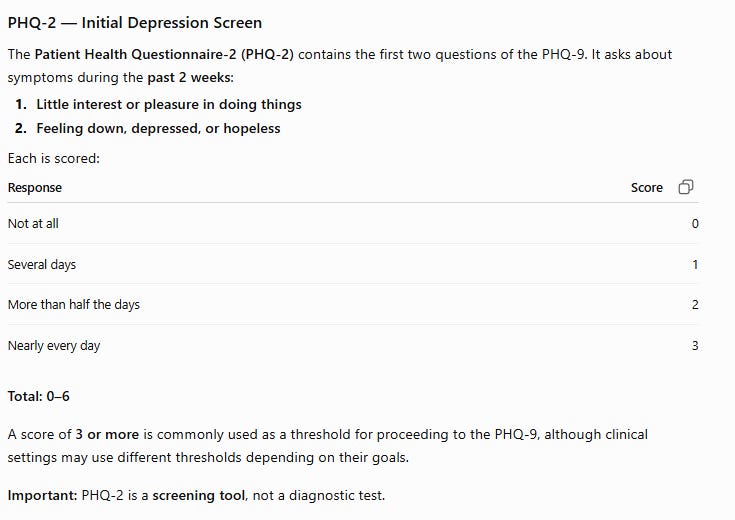
The PHQ-2 is a practical first step in primary care. It asks about two core symptoms during the previous two weeks:
Little interest or pleasure in doing things
Feeling down, depressed, or hopeless
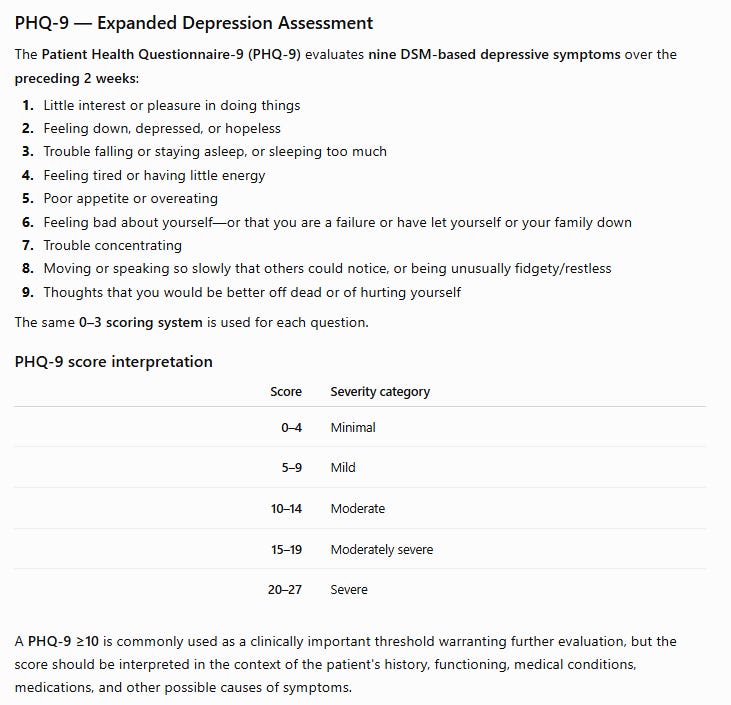
A positive PHQ-2 generally leads to the PHQ-9, which evaluates nine depressive symptoms and provides a measure of symptom severity. The USPSTF notes that the PHQ-9 is a validated screening instrument, but a screening score is not itself a diagnosis. A positive screen should be followed by clinical assessment, including duration, functional impairment, comorbid anxiety/substance use, medical causes, bipolar disorder, and suicide risk. (USPSTF)
The PHQ-9 item concerning thoughts of death or self-harm deserves immediate attention. If suicidal thoughts are present, the clinician should perform an appropriate suicide-risk assessment rather than simply recording the PHQ-9 score.
Other useful instruments include:
PHQ-9 — general adult depression - see FORM below at end of this article
PHQ-2 — rapid initial screen - see FORM below at end of this article
PHQ-A — adolescents
Geriatric Depression Scale (GDS) — older adults
EPDS — pregnancy and postpartum depression
GAD-7 — anxiety screening
AUDIT-C — alcohol misuse
MDQ or other bipolar assessment when bipolar disorder is suspected
The USPSTF recommends depression screening for adults, including pregnant and postpartum persons and adults ≥65 years, when systems are in place for appropriate diagnostic evaluation and treatment. (USPSTF)
How often should screening be performed?
Interestingly, there is no evidence-based universal interval such as “every six months” or “once a year.” The USPSTF specifically states that the optimal screening interval is unknown. Its pragmatic approach is to screen adults who have not previously been screened and repeat screening based on risk factors, comorbid disease, major life events, and clinical judgment. (USPSTF)
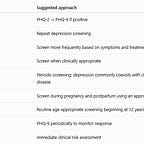
For a primary-care practice, a reasonable operational approach is:
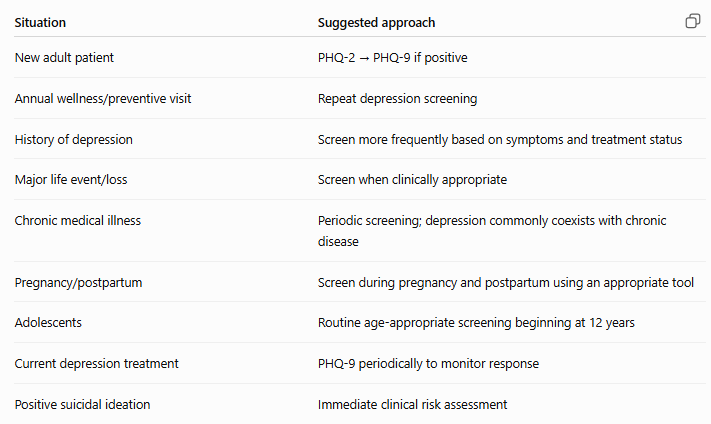
The important distinction is that screening frequency and symptom monitoring frequency are not necessarily the same thing. Someone actively being treated for depression may need substantially more frequent symptom measurement than a person undergoing routine preventive screening.
Alternative and Integrative Therapies for Depression
“Alternative” is best understood as complementary or nonpharmacologic approaches, because some have considerably stronger evidence than others. They should not automatically replace conventional treatment, particularly in moderate-to-severe depression or when suicidality is present.
1. Exercise
Exercise has substantial evidence as an adjunctive treatment for depression. Aerobic exercise, resistance training, walking, cycling, swimming, and structured exercise programs can improve mood, sleep, metabolic health, and functional capacity.
A practical prescription is:
30 minutes of moderate activity most days of the week, progressing according to fitness and medical status. NIMH specifically notes that even 30 minutes of walking daily can improve mood. (National Institute of Mental Health)
2. Psychotherapy
Psychotherapy is not an “alternative” therapy in the scientific sense—it is one of the first-line evidence-based treatments for depression.
Particularly useful approaches include:
Cognitive behavioral therapy (CBT)
Behavioral activation
Interpersonal therapy
Mindfulness-based approaches
Problem-solving therapy
CBT helps identify maladaptive thought patterns and behaviors, while behavioral activation focuses on gradually restoring meaningful activity and social engagement. (National Institute of Mental Health)
3. Mindfulness, meditation and breathing exercises
Mindfulness meditation, relaxation exercises, diaphragmatic breathing, prayer, and contemplative practices can be useful adjuncts, particularly when depression is accompanied by anxiety, stress, insomnia, or rumination.
NIMH specifically lists meditation and breathing exercises among activities that may help people experiencing milder symptoms. (National Institute of Mental Health)
4. Bright-light therapy
Bright-light therapy is particularly relevant when depression has a seasonal pattern. PBM or sunlight exposure.
For winter-pattern seasonal affective disorder, NIMH describes use of a 10,000-lux light box for approximately 30–45 minutes in the morning, generally during fall and winter. People with certain eye conditions or medications that increase photosensitivity should discuss this with their clinician first. (National Institute of Mental Health)
5. Sleep and circadian optimization
Sleep disturbance is both a symptom and potential perpetuating factor in depression. A structured sleep/wake schedule, morning light exposure, regular physical activity, reduction of late-night stimulation, and treatment of sleep disorders such as obstructive sleep apnea can be important components of a comprehensive program.
6. Nutrition and metabolic assessment
Depression should also prompt consideration of potentially reversible medical contributors. Depending on the clinical situation, evaluation may include:
CBC
CMP
TSH/free T4
Vitamin B12
Folate
Vitamin D when clinically indicated
Iron studies/ferritin when indicated
Testosterone or other reproductive hormones when clinically appropriate
HbA1c/glucose
Medication/substance review
Medical conditions—including thyroid disorders and some medications—can produce symptoms resembling depression. (National Institute of Mental Health)
7. Omega-3 fatty acids
EPA-rich omega-3 preparations have been investigated as adjunctive therapy, particularly in people who do not obtain adequate response from conventional antidepressant treatment. Evidence is more supportive for adjunctive use than for replacing established treatment.
8. Vitamin D
Vitamin D deficiency is associated with depression in observational research, but supplementation should not be presented as a universally effective antidepressant. NIMH notes that evidence for natural products such as vitamin D in depression remains inconsistent. (National Institute of Mental Health)
9. St. John’s wort
St. John’s wort (Hypericum perforatum) has demonstrated antidepressant effects in some clinical studies, particularly for mild-to-moderate depression. However, it is not a benign supplement. It can substantially alter drug metabolism and interact with numerous medications, including oral contraceptives, anticoagulants, immunosuppressants, HIV medications, and other antidepressants.
NIMH specifically warns about interactions and states that no natural product has FDA approval for treating depression. (National Institute of Mental Health)
There are many others that are useful. Saffron extracts and recently published SS piece on the Kanna herb for mood (see this SS here: Kanna herb for uplifting mood - by Yusuf JP Saleeby MD)
10. Brain stimulation therapies
For treatment-resistant or severe depression, non-drug interventions can include:
rTMS — repetitive transcranial magnetic stimulation
ECT — electroconvulsive therapy (old school and not done often)
Other emerging neuromodulation approaches
These are medical treatments rather than “natural” therapies, but they are important alternatives when conventional medication or psychotherapy is insufficient. NIMH recognizes both ECT and rTMS as established brain-stimulation approaches. (National Institute of Mental Health)
A Practical October Depression Screening Protocol
For a primary-care or functional/integrative practice, a useful workflow would be:
STEP 1 — PHQ-2
↓
STEP 2 — PHQ-9 if indicated
↓
STEP 3 — Suicide-risk question/assessment when indicated
↓
STEP 4 — Evaluate bipolar disorder, anxiety, substance use and psychosocial stressors
↓
STEP 5 — Review medications and medical contributors
↓
STEP 6 — Assess sleep, exercise, nutrition, social connection and substance use
↓
STEP 7 — Establish treatment plan
• psychotherapy/behavioral activation - we know who to send you to.
• lifestyle interventions
• medication when appropriate (not a first line but after all else fails)
• complementary therapies when appropriate (this is first line)
• referral to psychiatry/mental-health specialist when indicated
↓
STEP 8 — Repeat PHQ-9 to monitor treatment response
The key principle is “screen → confirm → assess severity/risk → treat → measure response.” Screening without a pathway for follow-up and treatment does not provide the full benefit of screening. (USPSTF)
Important: Anyone experiencing suicidal thoughts, intent, or an inability to remain safe needs prompt professional evaluation. In the United States, the 988 Suicide & Crisis Lifeline is available by call or text; emergency situations warrant 911. (National Institute of Mental Health)
———